




Humanity Returns to the Moon — And Comes Back Safely
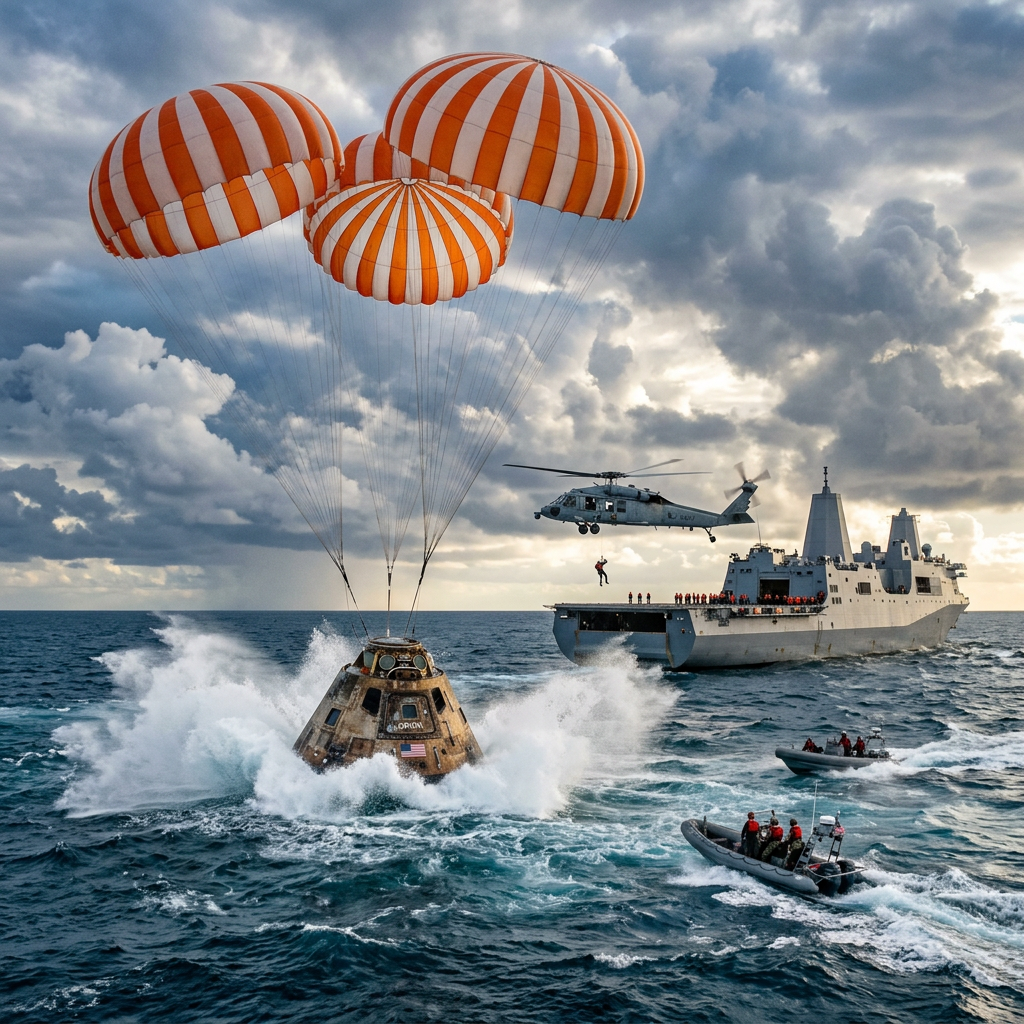
PACIFIC OCEAN / HOUSTON, Texas — In a moment that brought tears of joy to mission control and riveted the world, NASA's Artemis II crew splashed down safely in the Pacific Ocean off the coast of San Diego on Friday, April 10, 2026 — completing the first crewed mission to fly around the Moon in more than 50 years.
The Orion spacecraft's "Integrity" capsule pierced Earth's atmosphere at over 24,500 miles per hour before parachutes deployed flawlessly, slowing the craft to a gentle touchdown on the glittering waters of the Pacific. U.S. Navy recovery teams were on site within minutes.
The mission's 10 days in space — from launch to splashdown — captivated the globe and marked a pivotal turning point in NASA's Artemis program, which aims to return humans to the lunar surface within the next two years.
The Crew That Made History
Four astronauts completed the mission:
- 🇺🇸 Commander Reid Wiseman — NASA astronaut and veteran of the International Space Station
- 🇺🇸 Pilot Victor Glover — NASA astronaut, the first Black astronaut to fly on a long-duration lunar mission
- 🇺🇸 Mission Specialist Christina Koch — NASA astronaut and the first woman to fly on a lunar mission
- 🇨🇦 Mission Specialist Jeremy Hansen — Canadian Space Agency astronaut, the first non-American to fly on a crewed lunar mission
Together, they flew farther from Earth than any humans since the final Apollo mission in 1972 — venturing approximately 4,600 miles beyond the Moon at their farthest point, a distance record for crewed spaceflight.
"What a ride," Commander Wiseman radioed to Mission Control moments after splashdown. "We are humbled and grateful. America is back at the Moon."
The Technology Behind the Mission
The Artemis II mission was a masterclass in next-generation space technology — a demonstration that NASA and its partners have developed the systems capable of sustaining human life on deep-space missions.
The Orion Spacecraft
Designed from scratch for deep-space human exploration, the Orion capsule features:
- Advanced heat shield technology capable of withstanding temperatures of nearly 5,000°F during re-entry — hotter than the surface of the Sun
- A life support system that recycled air and water for the four-person crew over the 10-day mission
- A European Service Module built by the European Space Agency (ESA), providing propulsion, power, and thermal control
- Real-time communications systems that maintained contact with Earth across nearly a quarter-million miles of space
The Space Launch System (SLS)
The mission launched atop NASA's Space Launch System — the most powerful rocket ever flown. The SLS generated 8.8 million pounds of thrust at liftoff, enough to send the Orion capsule and its crew toward the Moon at over 22,000 mph.
Re-Entry and Recovery Technology
Artemis II's re-entry was one of the most technologically demanding phases of the mission:
- A skip re-entry manoeuvre saw the capsule literally bounce off the upper atmosphere before descending — a technique that reduces the g-forces on the crew and allows for more precise splashdown targeting
- 11 parachutes deployed in sequence to slow the capsule from hypersonic speeds to a safe splashdown velocity
- Upgraded recovery systems enabled the U.S. Navy to retrieve the crew faster than any previous splashdown
A Mission of Firsts
Artemis II was a mission packed with historic firsts:
| Achievement | First | |---|---| | Victor Glover | First Black astronaut on a crewed lunar mission | | Christina Koch | First woman to fly on a crewed lunar mission | | Jeremy Hansen | First non-American on a crewed lunar mission | | Crew distance record | Farthest humans from Earth since Apollo 17 (1972) | | Orion capsule | First crewed test of all deep-space systems |
The Road to Artemis III: Boots on the Moon
Artemis II was always the critical test before the main event — Artemis III, which aims to land astronauts on the lunar south pole for the first time in history.
The south pole is of enormous scientific and strategic significance: it contains permanently shadowed craters believed to hold billions of tonnes of water ice, a resource that could be used for drinking water, oxygen production, and — crucially — rocket fuel. Water ice at the Moon's south pole could become the foundation for a permanent lunar base and, eventually, a launchpad for crewed missions to Mars.
Data from Artemis II will now be analysed to validate life support systems, navigation technology, and the Orion capsule's performance across all mission phases. Engineers at NASA's Johnson Space Center in Houston began that work immediately after recovery.
Artemis III is targeted for launch in late 2027.
Mission Control Erupts
As the Orion capsule was spotted by recovery helicopters descending under its parachutes, NASA's Mission Control in Houston erupted in cheers. Flight controllers — many of whom had spent years preparing for this moment — embraced, wept, and punched the air.
The scenes were broadcast live around the world, and the emotional resonance was immediate: for many watching, it echoed the grainy footage of Apollo splashdowns, the crackling voices of astronauts returning from the Moon half a century ago.
But this time, it was different. This time, it was the beginning — not the end.
"This wasn't just a test flight," NASA Administrator Bill Nelson said from Mission Control. "This was proof that we are going back. And this time, we are staying."
Why This Matters
At a time when geopolitical rivalries are intensifying in space — with China accelerating its own crewed lunar programme and aiming to land astronauts on the Moon before 2030 — the successful return of the Artemis II crew carries enormous strategic significance.
The United States has reaffirmed its position as the world's leading spacefaring nation. The Artemis programme represents not just American ambition, but an international coalition: NASA is working with ESA, the Canadian Space Agency, JAXA (Japan), and a growing network of commercial partners including SpaceX, Blue Origin, and Lockheed Martin.
The Moon is the next frontier. And humanity — after a 50-year absence — is finally going back.
Key Mission Statistics
- 📅 Launch Date: April 1, 2026
- 🌊 Splashdown Date: April 10, 2026
- ⏱️ Mission Duration: 10 days
- 🌕 Closest Moon Approach: ~80 miles above the lunar surface
- 🌌 Maximum Distance from Earth: ~268,000 miles
- 🚀 Maximum Speed: 24,500 mph (re-entry)
- 🌡️ Heat Shield Temperature: ~4,800°F
- 🔭 Next Mission: Artemis III (targeted 2027 — Moon landing)
The New Dispensation will continue covering NASA's Artemis programme. This is a developing story — follow us for live updates.



Comments (0)
Be the first to share your thoughts!
Your voice matters. Every comment helps build our community.
Discussion Starters
No comments yet. Be the first to share your thoughts!