




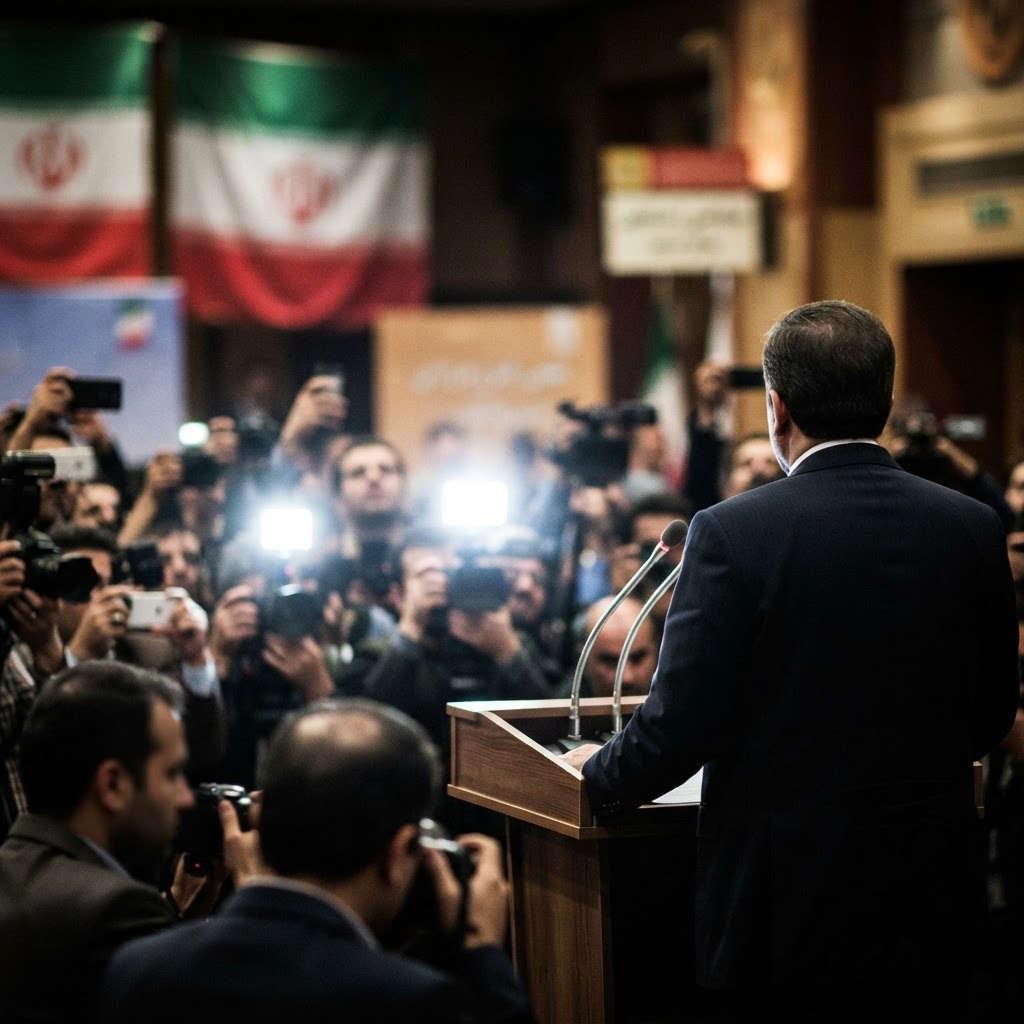
A Warning Delivered Straight From the Supreme Leader's Compound
TEHRAN — Iran's president issued his starkest warning of the conflict on Sunday, declaring that the Islamic Republic is "waiting" for the United States and that any American attempt to invade Iran with ground troops would end in catastrophe for the invaders.
"If the United States invades our country with ground troops, we are waiting for them," the president told reporters. "The United States will suffer in the hands of Iran."
The timing of the remarks was as pointed as their content. The president spoke just after emerging from a meeting with the Ayatollah, Iran's Supreme Leader — the man who holds final authority over the country's military and nuclear decisions. In Iran's political system, a threat delivered on the doorstep of the Supreme Leader's office is not a president speaking for himself. It is the state speaking with one voice.
Washington's Demand: Hand Over Everything
The warning lands in the middle of the most dangerous standoff between the two countries in decades. The United States has put a single, maximal demand on the table: Iran must hand over all of its nuclear weapons.
Washington's position, repeated across recent days, is that nothing short of the complete surrender of Iran's nuclear arsenal will de-escalate the crisis. American officials have framed the demand as non-negotiable, arguing that a nuclear-armed Iran is a threat the United States and its allies will not live with.
Behind the demand sits an implicit ultimatum — and it is that implication of military action, up to and including the possibility of American boots on Iranian soil, that the president addressed head-on on Sunday.
Tehran's Counter-Demand
But Iran is not simply refusing. In a move that reframes the confrontation as a negotiation between equals rather than an ultimatum to be obeyed, Tehran is making its own demands of the United States.
Iranian officials have made clear that any discussion of the country's nuclear program will come with conditions attached for Washington — Iran's price for the table, presented with the same take-it-or-leave-it firmness as America's demand for the weapons themselves.
The message from Tehran is deliberate: if the United States believes it can dictate terms, Iran intends to demonstrate that it, too, can dictate terms back. Neither side, as of this writing, has shown any sign of blinking.
Why a Ground War Is the Red Line
The president's specific invocation of ground troops is significant. Air and missile strikes, however devastating, are exchanges Iran has absorbed and answered before. A ground invasion is a different category of war — and one that military analysts have long described as extraordinarily costly for any invader.
Iran is roughly four times the size of Iraq, with a population of nearly 90 million, mountain ranges guarding its heartland, and armed forces — the regular military and the Revolutionary Guard — that have spent decades preparing specifically for the scenario of repelling a superior invading force. Its doctrine leans on layered defense, irregular warfare, and the ability to impose grinding costs over time.
That is the calculus behind "we are waiting for them": a declaration that Iran believes a ground war is the one fight in which the advantage tilts toward the defender.
One Voice, Two Audiences
The president's words were aimed at Washington, but they were also aimed inward. Appearing directly after an audience with the Ayatollah signals to Iranians that the country's elected and clerical leadership are aligned — that there is no daylight for outside powers to exploit, and no faction inside Iran preparing to concede.
For the United States, the choreography carries a colder message: the threat has the Supreme Leader's blessing.
Where This Goes Now
The standoff now rests on two irreconcilable public positions — Washington demanding the surrender of Iran's nuclear weapons, Tehran answering with demands of its own and a promise of ferocious resistance to any invasion.
Diplomats in Europe and the Gulf continue to press both capitals toward a negotiated off-ramp, warning that the alternative is a war that would engulf the region, convulse global energy markets, and — if the president's warning is taken at face value — exact a price in blood that neither nation has fully reckoned with.
For now, the last word belongs to Tehran: We are waiting.
This is a developing story. The New Dispensation will update as events unfold.

Comments (0)
Be the first to share your thoughts!
Your voice matters. Every comment helps build our community.
Discussion Starters
No comments yet. Be the first to share your thoughts!