





Reconstructed draft. The reported statement and financial figures still require source verification before publication. Images provide context and do not establish wrongdoing.
Monrovia, Liberia. Public revenue announcements should be accompanied by accounts that citizens can examine.
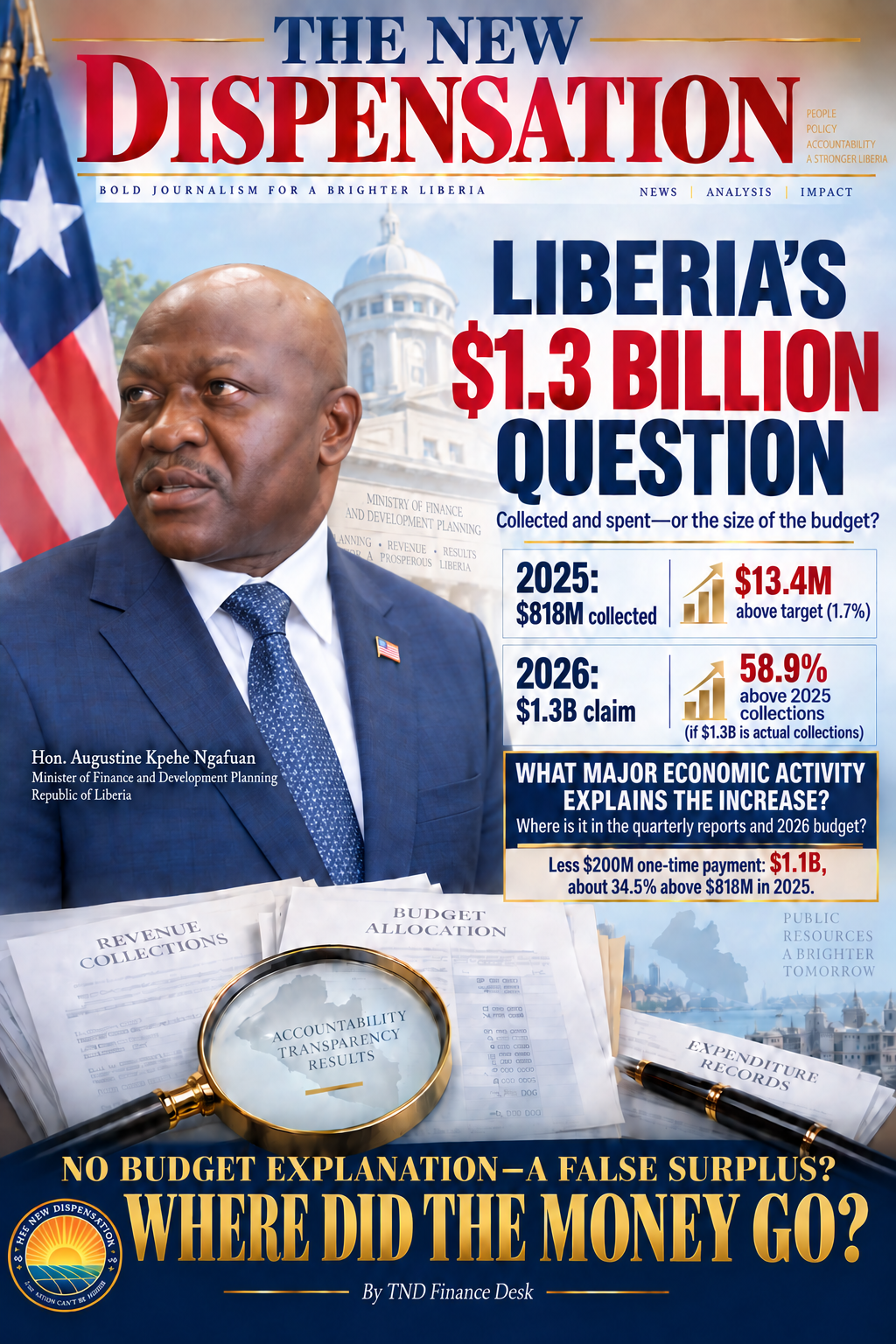
If Liberia collected $1.3 billion and that money has already been spent, the public deserves an account of both transactions: how the money entered the treasury and how it left.
The statement attributed to Finance Minister Augustine Kpehe Ngafuan—that $1.3 billion had been collected and spent—raises questions that cannot be answered by repeating the headline figure. What period did the amount cover? Did it represent domestic revenue alone, or did it include grants, loans, concessions, and other receipts? Under which budget and spending authorizations was it used?
These questions concern public money. Liberians have every right to ask them.
A large revenue announcement may suggest progress. But the size of an announcement cannot establish the quality of financial management. Citizens need records that connect collections to authorized expenditures and measurable public benefits.
What Exactly Was Collected?
Taxes, grants, borrowing, and one-time payments have different meanings. Borrowing creates repayment obligations. Grants may carry restrictions. Exceptional payments may increase receipts for one year without creating a dependable source of income for the next.
Combining these categories without explanation makes it difficult to assess the government’s performance.
The Ministry of Finance and Development Planning should publish a reconciliation showing the reporting period, each source of funds, the amount received, and the relevant budget classification. Revenue collection records should align with treasury accounts, with any differences explained.

A Revenue Increase Does Not Establish a Budget Surplus
Public discussion must distinguish between collecting more than expected and recording a fiscal surplus.
Revenue can exceed a collection target while government expenditure still exceeds revenue. A claim of surplus therefore requires a clear account of expenditure and the accounting basis used.
A percentage alone tells citizens very little. Surplus compared with what: the original revenue target, a revised budget, or actual expenditure? Does the calculation include unpaid obligations? Are loans being presented alongside revenue?
Without those explanations, a financial headline can create an impression that the underlying accounts do not support.
One-Time Receipts Require Careful Treatment
If exceptional payments contributed substantially to the reported total, the government should identify them.
A concession payment, settlement, or extraordinary fee can strengthen the treasury temporarily. It does not automatically justify permanent spending commitments or expectations of equally strong collections in the following year.
Responsible budgeting requires a distinction between recurring income and receipts that may never return. That distinction matters for salaries, schools, hospitals, infrastructure, and every service that depends on reliable funding.
“Already Spent” Requires an Expenditure Account
The assertion that the money has already been spent makes disclosure more urgent.
Citizens should be able to see which institutions received funds, what programs were financed, and how actual payments compared with approved allocations. Where spending departed from the original budget, the government should explain the changes and identify the authorizations.
Quarterly budget execution reports would help the public follow that process throughout the year. They would also allow legislators, journalists, and civil society to examine discrepancies while corrective action remains possible.

Accountability Must Follow the Announcement
Asking where the money went is a demand for disclosure. The question itself does not establish that money was stolen or misused. Evidence must determine any such conclusion.
The government can answer legitimate questions through accessible records: revenue statements, expenditure reports, financing schedules, and explanations of exceptional transactions.
Liberia needs strong revenue collection. It also needs public confidence that collections are accurately reported and spending serves the purposes for which it was authorized.
If $1.3 billion was collected and spent, the next step is straightforward: publish the accounts and let Liberians follow their money.



Comments (0)
Be the first to share your thoughts!
Your voice matters. Every comment helps build our community.
Discussion Starters
No comments yet. Be the first to share your thoughts!